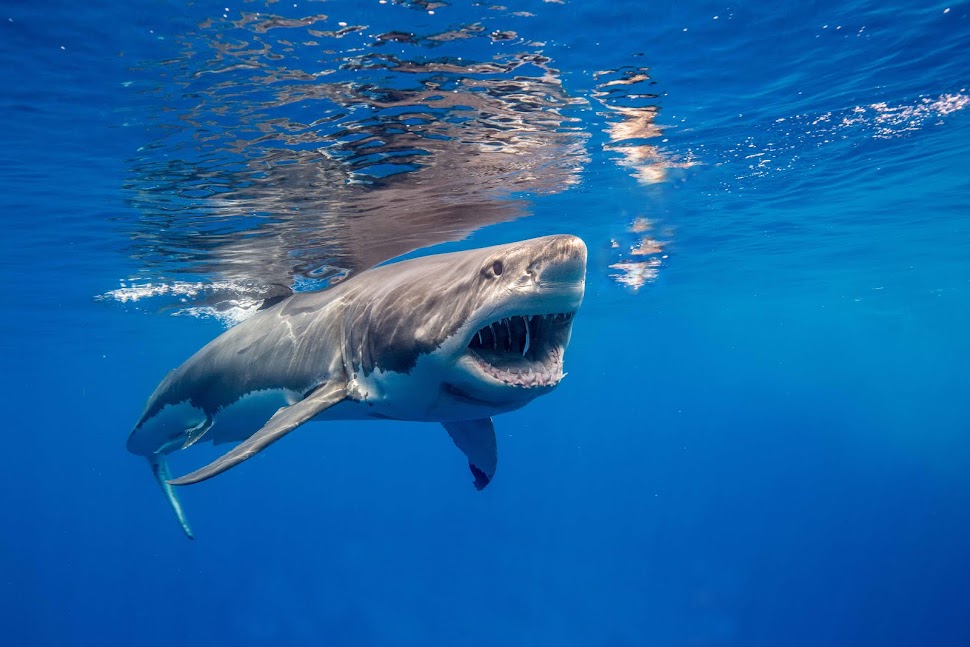
Farallones Tagging Mishap - RTSea Productions

Tuesday, November 10, 2009

However you want to characterise last weeks tagging incident at the Farallone Islands many within the shark community have unanswered questions.

RTSea Productions added their voice and overall assessment yesterday:

Controversy is now dogging the white shark tagging efforts of Dr. Michael Domeier of the Marine Conservation Science Institute. The SPOT (smart positioning or temperature) tagging began in Isla Guadalupe under the eyes of a film crew for a National Geographic Channel program to air on the 19th. It involves a technique whereby the shark is hooked and reeled on board, aerated with a water hose, while the crew literally drills and bolts a satellite transmitting tag to the shark's dorsal fin.

This is a rather elaborate tagging technique that has generated much concern within the shark conservation community (click here for prior posting about the Isla Guadalupe taggings, and here are two from other sites: click here and here).

Now, Dr. Domeier has moved northward to the Farallon Islands and, with the approval of Maria Brown, superintendent for the Gulf of the Farallones National Marine Sanctuary, has been tagging sharks there but with less than optimal success. Apparently, one shark swallowed the hook deep into its throat causing the bait's float to become lodged in the shark's jaws, thereby blocking access for the aerating water hose and requiring the cutting of the hook by working straight through the shark's gills. All in all a disaster in humane animal treatment as far as I'm concerned.

While there are concerns about the stresses this type of tagging places on the shark, there is also the question as to the need for more data acquired in the Northern California area. Dr. Barbara Block of Stanford, Dr. Pete Klimley of UC Davis, and others have amassed a considerable body of data that tracks the migratory patterns of these animals. They and their colleagues just recently issued a detailed report that can be viewed in the Proceedings of the Royal Society, published online on 11/04/09 in the Biological Sciences section ("Philopatry and migration of Pacific white sharks").

I always felt that this particular tagging technique was a more elaborate mousetrap than necessary. Now its efficacy has become controversial, the California data may ultimately be redundant, and the National Marine Sanctuary must defend a decision to allow catching a protected species in a manner that would most likely not be allowed for, say, a protected marine mammal.

Too many questions, too much controversy. . .

Read article in Bay area bohemian.com.

Read more...

SSACN Searches for Shark Officer

Monday, November 9, 2009

The Scottish Shark Tagging Programme is delighted to announce they have been awarded a funding package worth £52,000 to help support their data gathering on species of sharks, skates and rays found in Scottish waters, many of which are at risk.

The funding has been offered by Scottish Natural Heritage (SNH) and the Argyll and the Islands LEADER Programme and will be used to employ a Shark Project Officer who will work with SSACN to further develop the Scottish Shark Tagging Programme (SSTP – www.tagsharks.com) whose objectives are to :

  • Record data on shark, skate and ray species
  • Increase public awareness
  • Highlight the need for species protection
  • Encourage use of “codes of best practice”
  • Showcase conservation methods and efforts

Project Director Ian Burrett "SSACN has long campaigned for programmes aimed at regenerating the stocks of Scotland’s sharks; unfortunately the government and fisheries managers say they are unable to act as they say they lack the necessary scientific data and have no programme in place to gather it."

“Thanks to our funding partners and the many anglers who support our efforts, we shall be gathering that data for them.”

Tagging is the only non-destructive means of gathering the necessary data. It will be undertaken by volunteer sea anglers – fishing from the shore, kayaks or boats – who will catch, tag and release various shark, skate and ray species, either as part of their normal fishing trips or during major tagging events coordinated by the Shark Project Officer and SSACN.

The duties of the Shark Project Officer will also include arranging training workshops for anglers and raising awareness of Scottish sharks, skates and rays by liaising with fishermen, and visiting schools in Argyll.

Jane Dodd, SNH Marine Project Officer for Argyll and Stirling said: “We are hoping to recruit a dynamic project officer to lead this exciting project. Someone with project management skills and at least an interest in sea angling and a willingness to do some boat based field work. Quite an unusual range of skills to be found in a single person but we have our fingers crossed that he or she is out there!


Read more...

Spanish Fisheries Confederation - Sharks

Friday, November 6, 2009

The Spanish Fisheries Confederation (CEPESCA) will ask the European Commission (EC) to put forth international conservation and management measures for a variety of species of shark, among them, the thresher and the hammerhead.

It is hoped that the measures are proposed in the next annual meeting of the International Commission for the Conservation of Atlantic Tunas (ICCAT), which will be held in Recife, Brazil, from 6 to 15 November.

Last September, Spain prohibited the capture of thresher sharks and scalloped hammerhead sharks – in an effort to protect both vulnerable species.

According to the norm, Spanish fishing ships are not be able to catch, transfer, land or commercialise these sharks in any of the fishing-grounds they target.

“In written documents sent as much to the Spanish Administration as to EC Fisheries Commissioner Joe Borg, CEPESCA insists on the need for the European Commission to chair the ICCAT session on the necessary initiatives for the protection of the most vulnerable species of sharks and in the setting of the most adequate management measures for the establishment of responsible and sustainable fishing,” the Confederation indicated in a statement.

Complete Story.

Read more...

Tagging Disaster at Farallons - Foul Hooked Media

Thursday, November 5, 2009

For the past few days we have been receiving an ongoing series of emails and phone calls from a variety of sources concerning an invasive SPOT tagging effort at the Farallon islands.

There was an apparent "tagging accident" this week covered in graphic detail by Bohemian Magazine.

SPOT tagging is a white hot issue within both the commercial shark diving community and shark research community. The SPOT tagging technique employs crews to catch white sharks with large hooks and to drill tracking tags into their dorsal fins.

A person identified as "Chris Fischer, owner Mothership Ocean, Expedition Leader," has been refuting and then negating the seriousness of the alleged tagging accident by responding to question asked of him by posters at this blog:

"On the anchor at the Islands now. Happy to report in that the first shark has pinged in 4 times and seems to be doing well. The second shark has also pinged in. Both are still in the area."

"We hooked two sharks this week. We were concerned about the first shark because the hook was a little deep. It was in the back of it's mouth, not gut hooked. We were able to cut the hook in half so it could roll out backwards, and left a part of it in the shark."

The Making Of Media Disasters

This is a classic example of a media disaster in the making for the tagging team at the Farallons and one that could be addressed by getting ahead of the negative and extremely graphic media that is surfacing around this incident.

Two issues need to be addressed immediately.

1. The full extent of the tagging mishap. Images, video, and a full accounting of this event as it transpired with nothing held back.

2. The role film and television productions had in this event if any.

The event was witnessed, photographed, and video taped by multiple sources so it cannot be hidden or downplayed. At stake is the reputation of a well known shark researcher and National Geographic television show about this teams tagging work set to air Nov 16, 9pm Est/Pacific.

The tagged shark is said to be "doing well" by this team. With the abject lack of transparency about the mishap to date we're now asking for "proof of life" to be added to the media list with the inclusion of a recent tracking map of all animals tagged including the first one.

This data should be independently verified by resident shark researchers from TOPP.

In a moment of media foresight this week we pointed to the unprofessional image of this group "high fiving and smiling" around a grounded shark at Isla Guadalupe and suggested "in the end these images will dog your continuing efforts for years to come."

Shark researchers have as much responsibility for media handling as any group that interacts with charismatic mega fauna and in the case of the team at the Farallons doubly so. We're not the only ones to point this out see also Mark Harding has a point.

Media transparency surrounding this event is critical for the sake of continued research with white sharks and for the public perception of invasive techniques for animal science.

Read more...

Philopatry and migration of Pacific white sharks

Fascinating reading coming from The Proceedings of The Royal Society this week (click on image) with tracking/DNA data from a multi year effort at the Farallons, Point Reyes and Ano Nuevo off the coast of California.

Paper Highlights

"Hawaii is likely to be an important foraging area for white sharks. Extensive use of waters surrounding the Hawaiian island archipelago in winter and spring was evident from 13 satellite tag records (22% of tags with offshore tracks) and five acoustic tags (10% of 2006 and 2007 deployments) detected opportunistically by receivers stationed near the islands of Oahu and Hawaii (together comprising six males, six females and six unsexed individuals) (figure 1). The most precise geopositions and acoustic records from Hawaii included Argos endpoint transmissions (n = 8) with location errors of 150 m s.d. (Teo et al. 2004) and acoustic tags detected at fixed locations (n = 5). These occurred in slope and near shore waters along the entire 3000 km archipelago from the big island of Hawaii extending through the Papahānaumokuākea Marine National Monument to Laysan Island and Midway Atoll (electronic supplementary material, figure S2). While this distribution includes areas with colonies of endangered monk seals (Baker et al. 2007), detailed dive records from four recovered satellite tags (three females and one unsexed; three separate years) indicated that the dominant behaviour, when not transiting (Weng et al. 2007), was a precise diel vertical migration, between the surface and 600 m, consistent with foraging within the deep scattering layer community (Shepard et al. 2006) (electronic supplementary material, figure S3)."

Read study here.

Read more...

Sharksafe.org Adds Multilingual Support

Certification Program Uses Chinese and French Versions
to Raise Awareness of Shark Conservation.


Oakland, Califonia - November 2009 -- The Center for
Oceanic Awareness, Research, and Education, known more
commonly by its acronym "COARE", announced today the
availability of multilingual resources for its Shark
Safe certification program.

The website, www.sharksafe.org, which allows both
consumers and businesses to learn more about the Shark
Safe certification program, is now available in several
languages, including Chinese and French.

Using an easily recognizable logo to distinguish
participating establishments, the Shark Safe program
offers certification to qualifying restaurants and
select businesses that demonstrate a measured commitment
to shark conservation. Now available in several
languages, the website is expected to reach and
influence an even greater audience.

"The need for shark conservation is a global issue, so
our efforts need to transcend international borders,
cultural differences, and language barriers," said
Christopher Chin, COARE's Executive Director.

"We're particularly proud of and excited about the
Chinese version of our website," said Chin. "The vast
majority of sharks that are killed are taken for their
fins, which end up in shark fin soup - a delicacy
entrenched in Chinese culture and tradition."

"With an estimated 1.3 billion native speakers, Chinese
is, by far, the most widely spoken language on the
planet, and we are thrilled to be able to extend our
message to such a key audience," said Pete Wang, one of
COARE's volunteer translators.

"We have observed that a number of well-intentioned
shark conservation efforts have failed to persuade their
intended audience, and sometimes even alienated those
they meant to engage, because they failed to account for
language and cultural differences," said Richard Nelson,
one of COARE's directors. "Our program takes both
language and culture into consideration, and works with
communities to decrease the demand for products that are
harmful to sharks and the ocean."


The mission of the Shark Safe certification program is
to protect oceanic ecosystems by encouraging practices
that do not negatively impact shark populations.
"Sharks are one of our oceans’ top predators, keeping
the entire ecosystem in check, but shark populations
have declined dramatically over the last few decades as
a result of human greed and lack of understanding,"
said Chin. "If people knew more about these animals,
they would want to protect them."

As a conservation based website, www.sharksafe.org also
offers information about the plight of sharks and about
the need for their conservation. As further development
of the website continues, it will serve as a portal for
consumers to locate certified Shark Safe establishments
quickly and easily.

COARE began development of its Shark Safe program in
early-2007, seeking to protect sharks by raising
awareness of threats to shark populations and by
reducing the demand for shark products. In July of
2007, Jim Toomey, the artist behind the popular
syndicated cartoon Sherman's Lagoon, joined the effort
and helped form the Shark Safe logo in use today.
"Sharks have resided in a dark corner of our mythology
for thousands of years, which is partly the reason why
saving this vital animal from extinction will require a
special effort," said Toomey.

About COARE

The Center for Oceanic Awareness, Research, and
Education, Inc. (COARE) is a tax-exempt nonprofit
organization based in the San Francisco Bay Area. Its
purpose is to study our oceans and increase public
awareness of the earth's marine environment through
educational programs and outreach. COARE seeks to
enlighten people, young and old, to the plight of the
oceans, to change the way they think and act, and to
encourage them to create positive and lasting change.
For more information about COARE, visit
http://www.coare.org.

COARE, Shark Safe, and the Shark Safe logo are
trademarks of The Center for Oceanic Awareness,
Research, and Education, Inc. All other company names
or marks mentioned herein are those of their respective
owners.

Media Contact
Jennifer Bowyer, media@coare.org, +1-510-495-7875

Read more...

Farallons White Sharks, Research and Duplicity of Effort

Wednesday, November 4, 2009

There's a small brush war going on right now between two white shark tagging teams at the Farallon islands off the coast of San Francisco.

We covered it obliquely this week.

After some consideration I have come to ask the question "why are we re-tagging a large number of animals at the Farallons?"

Since 2000 a team comprised of the PRBO, U.C Davis and Stanford University or TOPPS have set close to 179 sat tags in animals in and around the Farallons. For the most part this effort has been a resounding success and with over eight years at this site the TOPPS team would be considered "resident researchers."

So when ambitious plans for a much more invasive tagging technique (spot tags) were unveiled by a completely new tagging team, who had little to no experience with the white sharks at the Farallon islands, many became curious, some became outraged.

We became curious this week as well. We support any and all white shark research as long as it is done by well funded professionals with real and lasting research goals. But the question remains, with over 179 sat tags in place and well defined movement patterns established what data could the introduction of more tracking and movement tags deliver?

Additionally, if new data could be acquired, why was the TOPPS team not intimately involved?

Unanswered question for now as this new team, with NOAA's blessings, continues to set a new series of invasive tags at the islands this week.

Cheers,
Patric Douglas CEO
www.sharkdiver.com
www.sharkdivers.com
www.sharkdivers.blogspot.com
www.guadalupefund.org
www.islandofthegreatwhiteshark.com
415.235.9410

Read more...

White Sharks San Francisco Bay?

Recent white shark tagging data has delivered a bombshell, white sharks visit San Francisco Bay.

From 2000-8 a team of researchers from U.C Davis and Stanford have been tagging white sharks in and around the Farallons and Point Reyes Seashore.

The very in depth story was covered today in the Mercury News and for white shark folks is a must read.

The other bombshell, not mentioned in this article was additional data showing Farallons white sharks off the coasts of Oahu's North Shore.

Confirmation of one of the commercial shark diving industries greatest white shark encounters back in 2007.

Read more...

"Oceans" That's French for "Beautiful"

Tuesday, November 3, 2009

What began five years ago as an undersea voyage to document the blue earth will be on screens January 27th - and those that live on the earth part will never be the same again.

Oceans a film by Jacques Perrin and Jacques Cluzaud will be the defining underwater film of the decade.

The interactive website is a must see, and for those of you lucky enough to see the film release in January just remember we told you so.

Kudos to magnificent blue films.

Read more...

Blue Bloggers Welcome Sean Paxton

Monday, November 2, 2009

"Juggling sharks, chainsaws and bowling balls is a personal metaphor adopted for my life and all the opportunity and challenge that makes it worthwhile. In reality, sharks do consume large portions of my time and energy, but it's the connected totality of the world's wild parts that fuels a passion for their long-term sustainability. Dull moments be damned. Here's a stout cocktail of adventure and wildlife; of risk and reward, and an exploration of how it all ties together in some of the strangest ways imaginable. If so much of this wasn't from personal experience, I probably wouldn't believe me, either."

Thus introduced, welcome to the newest addition of the Blue Blogosphere - Sean Paxton

Who are the Blue Bloggers?

As I have come to know them they are thinkers, innovators, trend setters, and conservation gurus. They are those who see things in all shades and beyond the horizon, they are the ones who shape current conservation issues, and sometimes move mountains.

For those who have not yet met the Blue Bloggers, you'll see their work in the shaping of ideas and conservation thought, in new websites, new media direction, and changes in old behavior.

The conservation world needs independent and controversial thoughts, smart ideas and conservation direction.

This is Sean Paxton.

If you were hoping for a dull assortment of "daily blarf", this blog is not for you. If you were hoping for something that challenges, enrages, and inspires, you came to the right place.

Sit back. Set your amps to 11 and please ensure your seat back tables are in the upright position...welcome to SeanPaxton.com

Read more...

Shark Survivability 0% To 80%

A very large percentage of "shark fishermen" are in fact "accidental fishermen" - like these fine examples from New Jersey.

After watching this video shark conservation folks can do two things:

1. Get angry and rail at all shark fishermen.

2. Produce the tools for shark survivability.

A series of well placed informational videos highlighting catch and release techniques with real sharks would "educate fishermen" how to save sharks. The fishermen in this video unknowing killed this animal. They just lacked any clear idea how to deal with a shark, from gaffing, to hook removal.

With an industry leader like, Guy Harvey, and the backing of the IGFA, these videos would do more for sport caught shark survivability then most efforts currently being promoted.

Education is the golden key to sport caught sharks.

As shark conservation folks why don't we lead this issue instead of reacting to it? Any takers?

Read more...

Duncan Brake, Jillian Morris - Shark Free Marinas

The Shark Free Marinas Initiative concept was created by the tragic death of a 15 foot Tiger shark in the Bahamas. We have posted about the power of "One Shark" to become the ambassador for an entire species. To make that happen ordinary people need to be engaged to effect conservation change.

The Shark Free Marinas Initiative sought ways to stop the ongoing slaughter of breeding aged sharks worldwide without becoming entangled in the often byzantine bureaucracy of local governments.

The initiative also looked at ways of empowering locals to take charge of their own regions, to become involved and to become conservation minded.

Lastly, the initiative looked at ways that local business could become green and promote that as a business selling point.

Nowhere are the three main goals of the Shark Free Marinas Initiative more aptly displayed but in the Bahamas and Fiji. This week Duncan Brake and Jillian Morris from Oceanic Allstars, both regional ambassadors of the SFMI in the Bahamas, produced an outstanding PSA for both the SFMI and for Bimini Sands Resort - the very first Bahamian Marina to adopt the SFMI.

Weaving the SFMI concept together brilliantly as a sales and conservation PSA, Oceanic Allstars have shown themselves to be savvy marketers of solid conservation PSA's.

After discussions with Luke Tipple, the Director of the SFMI, it was decided to invite Oceanic Allstars as our official PSA source for our entire marina directory. Now all marinas seeking PSA's for their marketing and sales have a direct and proven source to produce those PSA's.

Kudos again to both Duncan and Jillian for their tireless work as a regional ambassadors.

The Shark Free Marinas Initiative is a "people powered conservation concept." Along with Stuart Gow and Da Shark in Fiji the SFMI has grown exponentially.

Read more...

Guadalupe Island -Trip Report 2009

Editors Note: There are two kinds of people in this world, the dreamers and the rest. Kudos to Jen for being part of "the adventure clan."

Here's her story:

When I was 5, my aunt took me to see my first drive-in movie…Jaws. Now I know what you are thinking…that is way too scary of a movie to be taking a kid so young to, but that movie started it all for me. I have LOVED sharks ever since!!!

I wanted a shark cage just like Hooper’s and even a crappy boat like the Orca would do for my travels…but alas, I never got that shark cage that was on my Christmas list. So in creating my Bucket List, this is the first item - See a great white alive (preferably in the wild).

Flash forward to 2003…this is when I discover Patric and his wonderful company that takes people out to meet the magnificent white shark face to face in this magical place called Isla Guadalupe. I emailed Patric and asked him a few questions about the trip and he called me back and told me everything I needed to know and then some, in his made-for-radio voice. So I decided this was it, when I had the money and was ready to go, I was going with this guy!

Well in life things happen and priorities change and shark diving was put on the way back burner but was still going to happen someday.

So it is Monday, August 11, 2008 and I sit down at work to read my emails and one in particular catches my eye:

Hi Jennifer,

Congratulations you were drawn as our Grand Prize Winner for the Luke Tipple promotion. You have won the Dive with Great White Sharks at Guadalupe Island. I will send you out a pack in the next two weeks with all the information to book your trip, and connect you with SharkDiver.com so you can answer all your questions. (check out the SharkDiver.com website to get the general idea.) You do not need to be Scuba Certified for this trip.


I read the email over and over again in my head and then asked a co-worker to come read it and tell me what she thinks and she says, “it looks like you just won yourself a shark diving trip!” So I get on the phone to call my best friend, Nicole and I read the email to her and start crying, my lifelong dream is finally going to come true and it would be in September 2009!

I can’t say enough about Patric and the Horizon crew. Everyone was so nice and helpful from Aaron helping us with our weight belts to Mike being right there with a cold drink of water when we got out of the cages to Patric himself being kind enough to “Count” the sharks for us and Mark making sure that I never saw one piece of cilantro or raw onion on my plate! The whole crew was fantastic, the boat was clean and in order and the food was great. Martin, our dive master was very informative and extremely patient which came in handy when he was teaching me to clear my mask and regulator. I love the ocean and spend my summers snorkeling the southern California coast and this was my first time diving. It only took about 15 minutes to get the hang of breathing with the regulator and be comfortable in the cage and once the sharks arrived I forgot all about that regulator.

In the movies they always show sharks, whites in particular, with black, lifeless eyes, which does not help in them being feared but I can tell you that their eyes are far from lifeless. When a 15 foot great white swims 1 foot in front of your face you can see that it has a beautiful blue iris and as this shark swims past you can actually see it focusing on each diver.

They are very curious and cautious animals and whey they cruise past the cages you can’t help but look at them more as graceful than menacing. I was a shark lover long before this trip but seeing them in the wild has made me want to do more to help protect them and now I need to win the lottery so I can go on EVERY Sharkdiver.com trip EVERY season!

Yours in sharks,
Jen McCormick

Read more...

Following Expedition Blogs - Mining Gems

If there's an expedition blue blog out there we're probably following it.

The facinating world of our oceans is at your desktop each and every day. You never know what will catch your interest.

This caught our interest.

From the blog Oceans Watch Expedition, this post is called Aid Meets Tradition:

Chris comments: here in Moussau the community is still very traditional. I was interested to see how the fishermen use coral stones to weight their hooks to get down to 30 m where the bigger fish are.

They tie a piece of coconut palm leaf around the stone then put the hook through the leaf. When the stone hits the bottom a sharp tug pulls the hook out of the leaf leaving an un-weighted hook on the bottom. The bait they use is a piece of condom!

The condoms are supplied to the communities free by a family planning NGO. All the fishermen we met used condoms as bait and are very grateful to the NGO for endless free lures!

Read more...

Worlds Largest Oil Spill - On Fire

We have been covering what is now the world's largest oil spill. Ten weeks into the disaster a "blazing middle finger" erupted in the Timor Sea this week as the actual drilling platform caught on fire. No crews were on board at the time and no one from PTTEP the company responsible for the platform knows how it started.

The ongoing disaster is being curiously under reported by main stream media. Estimates of 400 barrels of oil being spilled each day are coming from the oil company and not independent agencies who estimate many more barrels are gushing from this once productive well head many kilometers under the sea bed.

Oil Disaster Week Ten Numbers

70 - Number of days the Montera Oil Platform spill has been sending oil into the Timor Sea.

74,000 - Number of kilometers the spill now covers (the size of Liberia).

11, 760,000 - Estimated number of gallons of crude oil spilled off the coast of Australia.


Read more...

NBC's Today Show D- on Sharks

If there was some kind of award for shoddy, hyper inflated, negative shark coverage, NBC's The Today Show would get it.

Over the past several years they have been the media leaders in 1970's style "horror shark" media hits.

If there was an award for honestly in shark media, new Blue Blogger Dorsal Fin would get it.

This week DF earned an extra tall shark statue for calling out The Today Shows ongoing and dare we say it, "moronically half fabricated shark based clap trap."

Actually, we liked that so much we'll say it again, "moronically half fabricated shark based clap trap."

The media's responsibility for balanced shark reporting is paramount and the only way they will be made to come to their senses is if we all take the time to point out when they stray completely off the media reservation.

In The Today's Show case that is several times a year, with few if any media hits highlighting research, science, and the ongoing decimation of worldwide shark populations.

Balance. In the world we live in it is needed now more than ever.

Kudos to Dorsal Fin for providing some.

Read more...

Fishing for Great White Sharks - Farallons

Sunday, November 1, 2009

Perhaps the biggest shark controversy in the western hemisphere is about to play out this week at the Farallon Islands - and no one it seems, is happy about it.

Just 27 miles off the coast of San Francisco these small, protected islands, are home to some of the largest white sharks in the region.

They are also home to notoriously horrific weather, murky cold waters, and a few die hard shark researchers.

This week the same team who caught and tagged white sharks at Isla Guadalupe, Mexico in 2008 will be at it again, this time at the Farallons.

White shark fishing was banned in California over 15 years ago and it is only with special permits that this team is allowed to catch these animals. Therein lies the controversy. Fishing for white sharks.

The team is lead by Dr. Michael Domeier from The Marine Conservation Science Institute in San Diego. We have been supportive of this team for the past few years. Mainly because they have an established track record for working with white sharks that few others have.

The hooking of any white shark is a traumatic event, but the data that comes back from specialized tags that are drilled into dorsal fins gives researchers a window into the world of the white shark that few other tagging methods deliver. Sat tags are notoriously finicky with a high failure rate. These tags allow researchers minute by minute updates and last for years.

With enough of these invasive tags in place we should, in just a few years time, have absolute and definable small scale and large scale movement patterns of a large sampling of the western pacific white shark population.

We would rather see a professional team do this kind of very specialized tagging work. NOAA, the agency for permit approval, has chosen well. Still many are abjectly opposed to these tags and the manner in which they are applied.

The bigger question is not so much the work that is being done, rather the film crews who will be accompanying the effort. It's a double edged sword when you look at any invasive animal technique and film and television productions.

Short media samples of the Guadalupe production are causing a backlash from the community.

While images like the one featured in this post cannot be helped, the perception that this work is in anyway "fun" are what harm the effort. Media control is, as we have always said, 90% of perception.

Gentlemen, a word of media advice from those who know.

Lose the "Cool Dude Shaka images" standing next to captured white sharks. In the end these images will dog your continuing efforts for years to come.

Let's hope Nat Geo's handling of your tagging program is as serious as the subject matter.

Read more...

Guy Harvey's Island Grill - Helping Out

Scotty Gray from Florida's Blue Iguana Charters had a problem only we could solve this month.

His buddy at Guy Harvey's Island Grill in Key West needed "something unusual" for this years Island Grill Halloween Fantasy Fest.

That "something unusual" was a Mark V shark cage, the kind that Shark Diver and Shark Divers keeps in storage all over Florida for film and television crews and for our use in the Bahamas and Cuba.

When we asked Scotty what they were planning for the cage he got a little vague, "well, you know, part of the big party this weekend I guess."

The big party featured Guy Harvey himself and an series of well known dive folks, locals, and we're told a few conservation folks as well. After all this is Guy Harvey's place.

The images from last nights party came back, and this one is the only one fit for print, taken very early in the evening. When folks in Key West celebrate Halloween, they celebrate Halloween.

Nothing gets held back and apparently our Mark V shark cage, designed for hard encounters with white sharks, tigers, and giant squids...was a hit with the ladies.

Glad we could help out. After all if you have shark cages, use them.

Read more...

Mossel Bay Shark Death - New Twist

It would seem there's a new twist in the widely reported story of a "Monster Shark" that was accidentally caught in Mossel Bay, South Africa.

Turns out the shark was caught some 1600 kilometers away from the Mossel Bay location and "trucked in" for a film crews shoot, contrary to multiple mainstream news reports and emails floating around the Internet.

Thanks to writer Martin Hatchuel who wrote us this week to offer the straight story. Martin is a travel writer for Mossel Bay tourism.

Media Release. Immediate. 28 October 2009.

Scientist Dissects KwaZulu-NatalShark in Mossel Bay.

Mossel Bay’s Oceans Research Laboratory last week dissected a massive great white shark which had been trucked into the town from KwaZulu-Natal, where it had drowned after being caught in shark nets.The animal was supplied by the Natal Sharks Board.

“The rumour mill has been working overtime, but the truth is that the shark was brought here so that the dissection could be filmed for a National Geographic television programme called ‘Inside Nature’s Giants’,” said Mossel Bay Tourism’s Marcia Holm.“The series will be shown on both National Geographic and on ’s Channel 4, and features experts from all over the world who trace each animal’s evolutionary history by exploring its internal anatomy.”

According to David Dugan, chairman of Windfall Films, the producers of the series, “When the [first part of] the series aired in the UK, it received universal acclaim in the press and it is now being nominated for many major awards.“A team of researchers and production personnel flew in from New York, London,Durban and to assist scientist Enrico Gennnari, who performed the dissection as part of the requirements for his PhD degree,” said Ms. Holm.

“There are people who want to be frightened by this poor creature, but it really is worth remembering that he was dead by the time he arrived in Mossel Bay,” she said.Mossel Bay has featured in a previous National Geographic production - called ‘Sharkville’ - which showed how, in fact, man and the sharks really do live side by side.“If anything, we’re more of a threat to them than they are to us.”

Ms. Holm said that the risk of shark attack remained low, and that swimmers, surfers and other recreational users of the oceans could mitigate this even further by looking out for - and avoiding - unusually high concentrations of sea birds and fish in the areas in which they were swimming.

“We don’t catch great whites in Mossel Bay as they are protected by the law,” she said.

Read more...

Sea Shepherd Crushing Dissent?

Friday, October 30, 2009

We have been critics of Sea Shepherd for the past year at this blog. Along with a growing number of others we have been hammering away at what appears to be a conservation org based on media fabrications, distortions, and an ongoing complete lack of credibility.

SSCS manages a 1970's direct action eco strategy that has all but failed to effect real conservation change. This strategy has been wildly successful in attracting millions in conservation donor dollars and a reality television show.

Dissent and Conservation

It is important that dissent is kept alive and well within the conservation community. Dissent and critique are the twin guides by which the conservation world polices itself. Or should be.

Global strategies and conservation efforts should be guided by clear and definable metrics for success. This is the basis of conservation. Choose targets well and roll out a careful and successful strategy to effect conservation change.

When conservation orgs fail to deliver conservation change they, as public entities, should be held to account. The money they accept is public money.

Sea Shepherd Conservation Society does not like dissent, or opposition to any of it's ongoing and very public conservation antics. We have discovered this first hand.

This blog is re posted on a series of blog aggregators and other sites. Over the past year SSCS has been quietly emailing and demanding these sites take our critiques of SSCS down.

The implied threat is one of legal action by SSCS.

Using vague and varied legal terms, SSCS has accused this blog of falsely reporting "facts" and basic muckraking against SSCS.

These are counter accusations coming a conservation group featuring Paul Watsons ongoing claims and faked video that he was "shot by Japanese whalers." A media "fact" that has all but been completely discredited including most recently by popular media's South Park.

When conservation critique is quashed, we lose the ability to guide the overall direction of conservation efforts. The very efforts that the public funds through donations.

We are all in the business of real and lasting conservation change - or should be.

This blog will continue to point out failed eco strategy in the hopes that change will happen. The fact SSCS chooses to deflect dissent is one indication that we are on the right track.

Faked hostage events, faked attempted assassinations, and made for television vessel rammings do nothing to save whales, sharks, seals or change eco policy in any country. Recently SSCS suffered a multi million dollar loss when the Canadian Government sized their sister vessel the Farley Mowat and sold it at auction. Seals will be slaughtered again this spring and the entire SSCS seal campaign was a loss, both monetarily and to the conservation movement.

To those few who support SSCS the world has changed since the 1970's. We need new strategy, new conservation goals, and new direction, not hyper inflated eco media.

Consider what you are doing, what you have been doing, and ask yourself...has anything really changed? Where are the solid, lasting metrics for conservation change?

Read more...

Mossel Bay Shark Death Confirmed

Images like these serve as reminders that big sharks are not safe anywhere.

Rumors of a large shark caught in Mossel Bay, S.A home to several commercial shark diving companies have been floating around the industry for weeks:

"Commenting on the shark in the photographs, Geremy Cliff, head of research at the KwaZulu-Natal Sharks Board, confirmed that the 4,3-metre shark was caught in the shark nets off Zinkwazi beach on August 31."

We have been posting about how the death of just "one shark" can become the instrument for shark conservation change. Perhaps this shark will be that animal. For the many commercial shark diving companies in that region the loss of such a big animal will be felt. In the end it will be up to them with a coalition of NGO's to seek the regional changes necessary to save these magnificent animals from further catches.

S.A newspaper, The Witness, has the complete story.

Editors Note: See surprising update.

Read more...

Sea Shepherd - Popular Culture and South Park

Thursday, October 29, 2009

When Sea Shepherds plans for a new reality television show with Animal Planet were announced - we had to the following to say about it:

"Perhaps one of the most chilling departures from the entire 40 year global eco movement was this year when Sea Shepherd traded it's last shred of dignity and credibility for the cameras of Animal Planet and thus began Eco-Edutainment Television, where media messaging and outright fabrication of events have subsumed the horrors of actual whaling. Where dead whales and story lines are traded with advertisements for SUV's and laundry detergent. This is a meeting of eco media and horror that never should have happened and now that it has will change the landscape of the global eco movement for years to come."

No truer words have been written about the ongoing embarrassment to the global eco movement that is Sea Shepherds Whale Wars.

We're not the only ones to take notice, popular culture commentators South Park decided to expose Sea Shepherd this week in what can only be described as "Skewering the Emperor with no clothes."

We have been covering Sea Shepherds media rise and mistakes for the past year in an ongoing series of blog posts. In one year Paul Watson and Sea Shepherd have managed to completely redefine the term for "conservation," taking the concept from quantifiable metrics for eco success to a series of often inane talking points and million dollar media spectaculars that leverage main stream media's desire to sell advertising as their conservation vehicle.

Meanwhile whales keep being killed, year after year, while Whale Wars ratings climb. It is high time we discuss and enable real and lasting conservation efforts. Reality television shows are not conservation, and fortunately South Park has just embedded that idea with the next generation of conservationists.

Sometimes the best way to enact conservation change is with a popular culture backlash.

Unfortunately Sea Shepherd is soon to announce a new reality television show with sharks in the coming weeks. We're pretty sure the folks at South Park are looking forward to that announcement as well, while the rest of the shark conservation world cringes at the prospect.

See complete Whale Whores episode here.

Read more...

Australia's "Monster Shark" - The Facts

Wednesday, October 28, 2009

The news media is having a field day with the story of a 10 foot white shark with two giant bites out of its side, indicating that perhaps a much larger shark, as large as 20 feet might have been involved.

We took a look at the images this week and came to the conclusion "if" this animal was in fact 10 feet long, these bites could be the result of a very, very large white shark.

Some have cried foul and declared this image to be photoshopped, others have suggested this image is a complete fake. Still others have said that men, not a shark, carved up the carcass.

We decided to find out the truth and made a series of phone calls to various agencies in Australia today and here's what we know:

1. This is a real image, or so says The Queensland Primary Industries and Fisheries manager Tony Ham who told us "this is a confirmed 3.3 meters white shark, caught by our contractor, he measured the primary bite mark at 50 centimeters or twenty inches."

2. The sole contractor who catches sharks in the region has been doing so for Queensland Primary Industries and Fisheries since 1986.

3. Tony Hams team estimate from the 50 centimeter bite radius, the feeding shark was in the 5.2 meter range or 16-17 feet.

4. Samples were collected from the bitten shark. The shark was dumped at sea following standard protocol. The bites were so severe that the head actually fell off the animal during transit shortly after this image was shot.

5. These are not man made holes in the side of the shark according to Tony Ham, "it is not a faked photo, the photo is absolutely genuine."

Tony Ham went on to say after they released this image to the media and the estimated size of the feeding shark "the sharks size grew by a meter overnight."

Read more...

Cage Diving Trip Report - 2009 Guadalupe Island

Editors Note: As a solo female diver from Finland we were excited to meet Sanna Juntunen in person this year.

Fun, adventurous, and always ready for the next shark rotation, nothing could stop this exceptional adventure seeker from discovering her "moment of white shark bliss."


From Finland to Isla Guadalupe – September 8-12-2009


"If we can dream it, we can do it”. This is a phrase I saw in Disneyworld, Florida almost 20 years ago and the same phrase came into my mind again last year when I was looking information about great white shark diving at Isla Guadalupe. "Should I finally make it happen? Well..why not!”

I was aware of the "shark finning situation” and the need of ongoing research and wanted to find an operator that really takes these things seriously and gives effort to saving these beautiful animals and also knows how to work on site on sharks condition. From these basis, Shark Diver came out the most convincing option. A decision I never had to regret.
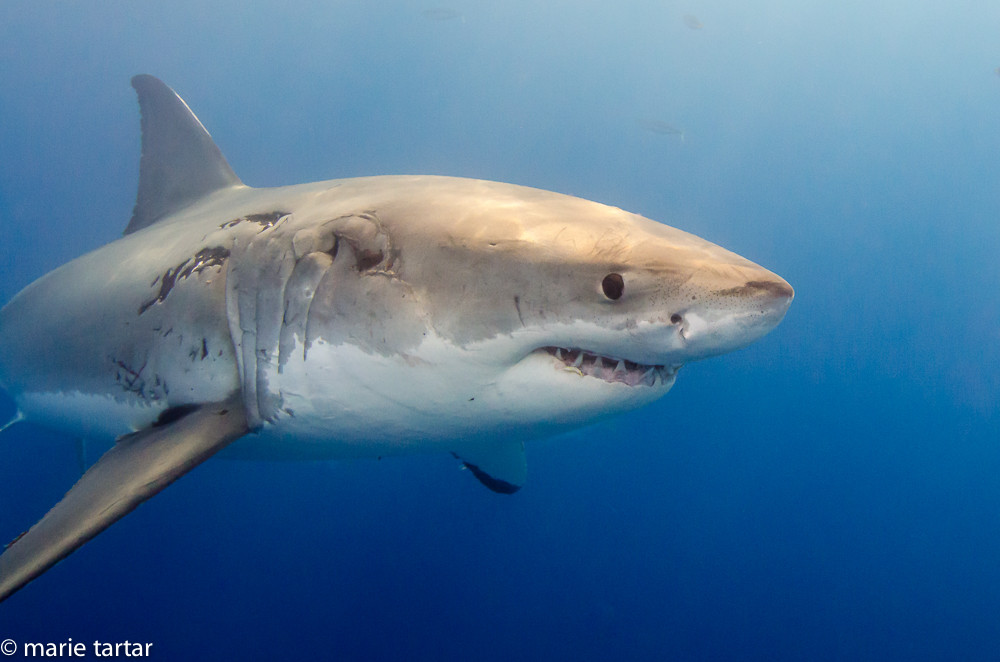
After almost 7000 miles of travelling I was finally on board MV Horizon on my way to Isla Guadalupe. Seeing ”the shark fin rock” the next morning and hearing Shark Diver CEO Patric Douglas saying ”Welcome to the island!” was the moment I had been waiting for the last ten months.

Less than one hour later I was in a cage with my camera admiring the underwater sights and waiting for the first sharks to appear. Finally, during the second rotation, I saw a dark shadow coming towards the cage and after a couple of seconds it was no longer a shadow..it was the most gorgeous creature I could ever imagine. The shark swam slowly past the cage and I could see it curiously looking at us. Suddenly it was gone but only for a short moment. During the day more sharks appeared and they continued to circle around the vessel and the cages the whole time we had rotations.

All three days of diving were incredible and offered an amazing opportunity to take photos and video and see how the sharks behave in their natural environment. When there are only a couple of inches between you and a 14-foot shark that looks straight into your eyes it makes you feel humble and privileged to be able make this visit to the world of the great whites. There are no words to describe that feeling!

If I can remember correctly we saw a total of 13 different sharks. Also a very big plus was the second night when marine biologist Mauricio Hoyos-who does a great work with the sharks-gave us a very informative lecture about his research at Isla Guadalupe. Now I also know how ”Mau” got his name;-)!

On the last day the crew gave us an opportunity to take a boat ride to have a closer look of the island and it's other inhabitants: sea lions and elephant seals among other things. A very nice extra! At this point I want to say a BIG thank you for the whole crew: Spencer and Wayne, Aaron and Cary, Mark and Mike (great food!) and divemaster Martin. You guys were always there to offer your help and made this trip even more successful!

And Patric from Shark Diver, thank you very much for being so helpful from the moment I contacted you. With your help it was a lot easier to make all the required arrangements and it was also great to meet you in person!

After all, the trip was everything I expected and even more! Hopefully in the future I will have an opportunity to get more shark diving experiences. "If we can dream it..."

From Finland,

Sanna Juntunen
Helsinki, Finland

Read more...

Sport Diver Magazine - SharkDiver.com

Tuesday, October 27, 2009

This month outdoor writer Jim Cornfield covered Isla Guadalupe, Mexico and Shark Diver for Sport Diver Magazine.

The article was a short update to Isla Guadalupe and commercial shark diving with several industry quotes from CEO Patric Douglas:

"Site stewardship is especially important here (Isla Guadalupe) in what is perhaps the most robust shark site on the planet."

Kudos to Sport Diver Magazine for continued positive coverage of the global shark diving industry.

It is articles like these that educate, entertain, and inspire.

Read more...

Thresher shark research & conservation project

Of the myriad of shark conservation sites worth visiting, none come better then the Thresher shark research & conservation project.

We have been following this site for the past year and are always happy with the vibrant field updates, images, video and news.

This months newsletter is a must read.

Consider taking the time to get to know the team behind the Thresher shark research & conservation project.

Shark conservation efforts are hard enough to get traction with, in places like the Philippines doubly so.

It's takes determination, good outreach, and a serious research program to make a difference.

Read more...

Casting White Sharks as Villians...Again

We have been keeping tabs on a new production in the works called The Reef.

This mornings news from Australia confirms suspicions that another "white shark attack film" is in the offing, just in time for 2010:

AN overturned hull is causing some consternation near Shelly Beach but the person most affected by the makeshift shipwreck is a movie character. Thankfully.

The character shall remain nameless. Best to say he or she meets a “grisly demise” in the waters of Hervey Bay this week and a great white shark is probably involved at some level.

Complete Story

Read more...

Body Glove Knows Shark Diving

It is refreshing if not downright appealing to notice the stance wetsuit maker Body Glove has taken in regards to the shark diving industry.

Where many makers of water apparel and dive gear shy away from commercial shark diving - Body Glove embraces it.

Kudos for the industry vision and the upcoming blog posts featuring twin shark expeditions with Body Glove, whale sharks and white sharks.

The commercial shark diving industry needs more outreach within the manufacturing side of the dive, surf, and water sports worlds.

As high profile ambassadors for our industry forward thinking companies like Body Glove can begin to dispel many of the myths surrounding commercial shark diving.

What begins as a blog post today, with a little vision, often becomes much more.

Read more...

Shark Trust Wines - Stocking up at $3.00?

Monday, October 26, 2009

Around this time of year we stock up on Shark Trust Wines. With the holiday season just around the corner, gifts, parties, and good old fashioned nights at home with a roaring fire call for wine...and lot's of it!

Melanie Marks, CEO of Shark Trust Wines emailed us this week with her seasonal offer to all our shark folks out there and yes, we know you like to drink.

For a limited time Shark Trust Wines is offering an outstanding deal for their 2007 Great White Chardonnay from Western cape, South Africa.

If you live in the San Francisco Bay Area, they are offering it at $3 a bottle.

Yes, that is correct - 70% OFF. Order for holiday gifts, your company holiday party, or just stock up your wine cellar. With this offer, you must buy by the case (12 bottles) and be willing to pick up the wine at the warehouse in Petaluma.

Get a group of friends to order together and make one trip to the warehouse. Please contact Melanie directly to order and make arrangements for pick up.

619-994-5933 or marks@sharktrustwines.com

Happy Holidays!

Melaine Marks - Shark Trust Wines

Read more...

That's One VERY Big Critter!

According to the always hysterical shark media in Australia this week, a 20 foot Great white shark is stalking the waters - or at least something as big as that with teeth.

This time though we had to pause for a moment.

The image of a ten foot white shark with two simply titantic bites out of it was enough to make us church going believers in "20 foot sharks."

The thing that got to us was the fact these bites appear to be singular events. What animal on the planet, aside from a killer whale, could possibly take 200-300 pound bites out of prey items in one pass?

Now where's our shark cage?

Read more...

Grand Theft Shark Conservation?

Saturday, October 24, 2009

Recently an apparent "Grand Shark Conservation Heist" happened within the shark community, and for the most part it went unnoticed and unchallenged.

It was a theft of intellectual property, the brazen day light robbery of ideas and a two year conservation plan that was not generated by, nor did belong to, those who subsumed it.

Intellectual property is as real as personal property.

In the conservation world intellectual property is the currency of the entire movement. Conservation ideas that are unique, powerful, and visionary are what move others who lack long term vision to conserve sharks.

The shark conservation movement started many years ago with the audacity of "an idea." To get people to look at sharks differently, to conserve a predator, to be engaged with the oceans. Though that kernel of an idea sprang those with other ideas, unique conservation thoughts, vision, and leadership.

Intellectual property is the sole ownership of an idea, concept, and vision. Vision is the key component to intellectual property. Like the first hominid that invented fire, the vision behind that first fire translated into charcoal hardened spear points, the cooking of food, the making of pottery, life as we know it.

This apparent daylight conservation robbery was so brazen, so bold, that the perpetrators did not even bother to change the name of the conservation org. They ignored existing URL's with the same name, they touted this new organization as a unique entity to them, subsumed the entire concept and conservation targets, and enrolled a host of ancillary industry names as legitimate cover for this brazen act.

They even filed for a cloned name trademark after ascertaining that one had not been filed yet by the originators.

To those who had their entire conservation concept stolen, this was an act that defied even rational discussion. Conservation Visigoths had stormed their castle and made off the the crown jewels - intellectual property.

To steal intellectual property is a base act. It has nothing to do with vision, leadership, or conservation, it is an act of theft, pure and simple. What is lacking from this particular theft is vision. Those who generate intellectual property, also generate vision and myriad of possible uses for the idea and concept.

Many within our community who watched this theft from the sidelines commented that it was "unfortunate," or "sad" and then went on to ally themselves with this new stolen org setting an ugly precedent about what is shark conservation and what is not. Many are unaware that this entire concept is the result of two years of careful planning by others.

Do we as a conservation community condone eating our own?

Like jackals descending on a conservation idea, no one in this theft asked the owners of the idea, the owners of the concept and vision, if they could band together and push that vision under the originators banner.

Instead, in backroom discussions with a handful of insiders, a Faustian bargain was made. Steal the idea, call it your own by placing your names on a website as the group leaders, and bring people to this new banner...all in the service of sharks.

Except this was not in the service of sharks. To be in the service of sharks is to look at the conservation world and seek a niche that is yet untapped, an idea yet undiscovered and build on that. Through multiple efforts the conservation movement - becomes an actual movement.

The audacity of many completely original conservation ideas made manifest, is at its heart, conservation.

We had our own unpleasant discovery this these same Conservation Visigoths. Our own shark conservation URL was cloned with a new name, bought without our knowledge, for a use that we can only assume had nothing to do with our completely original conservation effort. It still remains to this day under an "ownership" that went on to completely subsume this other effort.

The funny thing about intellectual property though, it leaves a well defined trail for those who want to look.

To those who have perpetrated one of the most brazen conservation heists of the past decade, rethink what you are doing. To give full and lasting credit to the originator of "your" concept would be the honorable thing to do. To turn over the website and URL's even better.

Real and lasting shark conservation is a brought about by ideas, passion, and execution of those ideas. Not theft, and re purposing for your own use.

You cannot steal the plans to an electric car, build on those plans, and call yourself green.

In the end it will be up to our community to set the standards by which shark conservation efforts are accepted. Many within the community decry the often childish backbiting that goes on between various conservation groups, with the thought of "why can't we all just get along?".

Standards. We need to accept some base level of conduct that is acceptable.

In my humble opinion, it starts with original ideas and those that would support them or callously subsume them without credit or even the knowledge of the originators.

We need to be in the service of sharks first and foremost.

To be in the service of sharks requires being unique, original, and that also requires leadership. Real and lasting leadership is not conferred by taking the hard won intellectual property of others.


Cheers,
Patric Douglas CEO
www.sharkdiver.com
www.sharkdivers.com
www.sharkdivers.blogspot.com
www.guadalupefund.org
www.islandofthegreatwhiteshark.com
415.235.9410

Read more...

Research on "shark risks" South Africa

Friday, October 23, 2009

With the anti-shark diving lobby in Hawaii now in "full hysteria mode," pushing shark attacks and a somewhat nebulous public safety argument - South Africa is quietly setting an example.

Missing from the Hawaii debate about commercial shark diving is definitive data. The anti-shark diving lobby has little interest in research and data, while in other countries, some might even suggest, more enlightened countries, the balance between sharks and man is one that will be decided by long term research and study:

WITH Nelson Mandela Bay positioning itself as the water sport capital of Africa, the municipality has given the go-ahead for research on sharks in the city.

This follows reports over the years of shark attacks at coastal towns around the country. At a sports, recreation, arts and culture committee meeting yesterday, councillors agreed the research was necessary to reduce the risk of attacks.

The committee agenda, signed by executive director Zolile Siswana, said “the objective of achieving the position of water sport capital of Africa could be threatened by the possibility of frequent shark attacks in the city”. “A single shark attack would have a negative impact on water, sports and tourism"

“This has prompted various interventions by the KwaZulu Natal Sharks Board and Cape Town Uni-City Shark Spotters programme. These efforts (shark nets and drum lines) reduced shark attacks tremendously.” Marine scientists in Nelson Mandela Bay do not have enough information on Great White sharks or data to establish the possible risk to the public and open-water events in the city.

They do, however, have information on shark populations, migration and behavioural patterns. According to Siswana, the economic development and recreational services shark contingency plan addresses the first-response aspect of shark attacks.

“This emergency plan is simulated regularly. As great white sharks are the biggest threat to the public, safety research would ensure a more efficient response time by our lifeguards and emergency services.” The municipality will commission a shark specialist and marine scientist to conduct the research.

Complete Story

Read more...

Amanda Cotton - Iconic Shark Image 2009

Tuesday, October 20, 2009

Every once in a very long while along comes THE iconic shark image of the year, sometimes even the decade.

This is the Iconic Shark Image of 2009.

Shot in the Bahamas by photographer Amanda Cotton it features well known free diver Wolfgang Leander and shark.

The balance, grace and simplicity of this image are some of its most potent qualities.

The image leaves the viewer with unanswered questions and stirs a full range of emotions from the encounter (click image for full size).

When you see this image in full size, you see the shark hook and trailing leader embedded in the side of the animals mouth - now the real questions begin, and the story unfolds.

Amanda announced her new website at the start of this month and we would like to direct your attention to her other work as well.

As for this image?

It is unique, compelling, and tells a story of man and sharks that transcends it's first look and even third. To say we are impressed with this image is an understatement.

Congratulations Amanda, for shooting "The Iconic Shark Image of 2009."

Read more...

WWF Understands Shark Tourism - New Report

A new WWF report in tandem with James Cook University highlights what the global commercial shark diving industry already knows, sharks are in decline everywhere.

What makes this latest report interesting are the drill down tourism numbers for live sharks vs fisheries.

Where short thinking, hyper political doom predictors in Florida, and now Hawaii seek to ban commercial shark encounters at least one credible NGO understands why shark tourism is good for local economies and yes, sustainable shark populations:

SHARKS are worth more alive than dead.

New research shows the ocean predators draw a healthy chunk of the tourist dollar.

WWF Australia spokesman Nick Heath says shark tourism is on the rise but shark numbers are declining, with estimates placing reef shark populations at three to 12 per cent of their original size in some parts of the Great Barrier Reef."We must do more to protect these top predators from disappearing on our watch, if not for the benefit of the environment, then at least for the benefit of the back pocket," Mr Heath said.

"A guaranteed shark sighting is worth its weight in gold to the tourism industry."

He said recent research by James Cook University found potential shark sightings were a major drawcard to the diving sector, with tourists willing to pay thousands of dollars to see a shark in the wild.

The researchers estimated up to 25 per cent or $1,375 of each visitor's expenditure in Cairns and Port Douglas in far north Queensland went towards the opportunity to see a shark.

Divers mostly want to see hammerhead sharks followed by whale sharks and tiger sharks, the study found.

The group says more than 70,000 sharks are taken by fishermen each year in waters off north Queensland, many inside the Great Barrier Reef area.

Sharks thus come under particular threat because of slow growth rates, late sexual maturity, long gestation periods and birthing only a few young at a time.

Complete Story

Read more...

Maui Bans Shark Tourism - Surfer Attacked by Shark

Monday, October 19, 2009

Not weeks after Maui City Council members voted to ban non existent commercial shark diving to "protect swimmers and divers" in Maui - a surfer was bitten this morning by an estimated 6-8 foot sand shark.

He was surfing in the "Kalama Bowls" area of a local beach park shortly after 6:00 a.m. when he was bitten on the upper right thigh and the lower part of his right ankle, according to Maui County officials.

The unfortunate negative intersection of sharks and humans will continue to happen regardless of commercial shark diving operations in any given area.

Maui has never had commercial shark diving in it's waters.

Shark do not target humans as a general rule.

Maui's political decision to ban shark diving was just that, a political decision, and with this mornings unfortunate incident proved one thing for certain...sharks do not regard political decisions.

Commercial shark diving is under assault by a global anti-shark diving lobby that trades in on the fear of sharks. When bans are proposed "public safety" is touted as the net benefit to the community at large.

With this latest case in Maui, the anti-shark diving lobby has been exposed for what they are.

Simply put, purveyors of fear based nonsense.

Read more...

Dr. Sylvia Earle's Deep Search Foundation - Whale Sharks

Isla Holbox is perhaps the best known commercial whale shark encounter sites on the planet. A surprising success story of commercial shark diving and growing site research and conservation.

With little known about these "gentle giants" a scientific expedition lead by Dr. Sylvia Earle's Deep Search Foundation chronicled it's time here from July 11th - 15th, 2009 in an in depth series of blog posts.

Great reading for those desk bound shark adventure seekers.

About Deep Search Foundation

Founded in 2008, Deep Search is dedicated to exploring and protecting Earth's ocean, the cornerstone of our planet’s life support system. More than 70% of Earth is covered by ocean, and 94% of our habitable space is in the seas. Yet, we have explored less than 5% of the ocean and protected only a fraction of 1%. These figures pale even further when one considers the deep sea.

Read more...

Brazil - Blue Shark Nursery?

With Blue shark (Prionace glauca) stocks plummeting worldwide, new discoveries like this one off the coast of Brazil might help turn the tide.

If protections can be put in place in time:

New evidence suggests a blue shark nursery exists in the Southwest Atlantic
near Southern Brazil, according to a paper accepted for publication in the
journal Fisheries Research.

Scientists Santiago Montealegre-Quijano and Carolus Vooren of the
Universidade Federal do Rio Grande monitored the composition and magnitude
of blue shark accidental catches by longline fishery operations off the
coast of Brazil. (At least something positive can come from such data.
Bycatch has really put a dent in shark populations worldwide.)

The researchers determined that large adult blue sharks were not present in
the suspected nursery region, only juveniles. Size appears to be very
important to life stage shifts in these sharks, as the small juveniles were
found to remain at the site until they reached lengths of around 4 feet or
more.

"After that stage," the scientists conclude, "the large juvenile males
disperse northwards, whereas the large juvenile females move to the south,"
and wind up going all the way to the southeast Atlantic off Africa.

The scientists added, "The subadult females move northwards in late summer
(March) to areas beyond latitude 25°S."

Complete Story

Read more...

Media 101 - How "not to" promote a reality show

Hands up, who did not watch the "Balloon Boy" media sensation last week either live, or on hand held devices like a Blackberry or iPhone?

One...two...three...o.k, four of you. Thanks.

For the rest of us, a few hours spent following what seemed like the gripping story of a flying saucer balloon with a wayward six year old child inside had at least 200 million Americans and a handful of Dutch enthralled.

Sadly it was a hoax. Remember the Bigfoot scandal, yes we covered that too.

There's a point to this post. There are good and bad ways to promote a show concept to the major media and without the proper media guidance, stunts like these set very bad examples with serious consequences.

The family is facing $500,000 in fines and a minimum of 6 months jail time. Our guess after the dust settles will be a quick documentary, bankruptcy from legal bills, and a divorce.


Read more...

Oceanic Defense - Filling a media niche

Saturday, October 17, 2009

As shark diving and long standing conservation media guys we're always on the watch for new and innovative ways to get a media message out to the public.

The media landscape in the past three years has changed dramatically. The addition of new media and it's ability to "move the message" has been a boon for a few NGO's and conservation groups who have been savvy enough to adapt to rapid change.

But what about the "million ant army" we keep talking about? The many multi discipline shark groups that lack the time and effort to get their conservation message out to a wider new media audience?

Enter Oceanic Defense "The gateway to new media."

Oceanic Defense is the perfect tool for the shark conservation movement and serves two strategic purposes. CEO and Director Jeff Shaw should be recognized for his vision and tireless efforts to bring solid conservation messaging to the masses - leveraging new media and doing so without agendas.

The shark conservation movement is two tiered. At the top well funded NGO's. At the bottom a growing base of websites, petition sites, activist groups, and message makers. These disparate groups often find conflict with each other as is the case with top tier NGO's.

This is the nature of the business of shark conservation.

Oceanic Defense brings the messages of all of these groups, without judgement, without agenda, focusing on the message to enable new media shark activists to act for the betterment of long term shark conservation.

We like it. We have allied ourselves with them on our Shark Free Marinas Campaign on Facebook and noticed a huge improvement in "eyeballs" to that campaign.

Oceanic Defense is the right media tool at the right time for a conservation movement that desperately needs media outreach.

Join them in the effort to conserve shark populations globally. As we have long said, real and lasting shark conservation starts with "One."


Cheers,
Patric Douglas CEO
www.sharkdiver.com
www.sharkdivers.com
www.sharkdivers.blogspot.com
www.guadalupefund.org
www.islandofthegreatwhiteshark.com
415.235.9410

Read more...

Great White Sharks - Julie Hazards Adventure

Friday, October 16, 2009

When the office phone rang this summer within minutes into the conversation we knew we had a shark fan on the other end of the line.

Julie Hazard turned out to be one of those shark people you come to love, and cannot wait to meet.

This is her story, encounters with the Great whites of Isla Guadalupe -2009

Julies Story

I have always loved sharks. I remember watching Jacques Cousteau and then 'Shark Week' as a child...I though shark diving was so cool and as I grew older it became an obsession.

When I was a senior in high school, I wanted to study Marine Biology and was warned by someone that it was hard to get a job...because you basically have to wait for someone to die to get a good field position. It turns out studying sharks wasn't a job you ever gave up once you had it.

So instead I became a member of a few shark conservation groups and I even have a shark tattoo on my ankle...did I mention that I love sharks?

A few years ago I decide to go dive with Great whites. I didn't know anything about the dives and wanted to get a great price for the dive so, I did some homework. Last year I found two companies that had pretty good shark diving deals and called to talk with them in person.

Unfortunately I was also in the process of changing jobs and decided to wait one more year. Let me tell you, that was one very looong year. I was laid off in November but I had saved the money for the trip and I was going to go.

I started talking with Patric the CEO of Shark Diver in Feb and I was so excited when I got the confirmation that I was going. Since I had no job at the time, it gave me something to look forward to. Imagine booking a trip with no job? Did I mention I really love sharks?

I had booked this great trip and was so excited I told everyone I knew what I was doing, twice! They all thought I was crazy!

Turns out the Shark Crew were very sweet to me as a single girl far from home, 210 miles in the middle of no where, surrounded by white sharks. They kept you very well fed, the beds were comfy, and of course the SHARKS were great. Something I could never see except in real life a 15 foot white shark face to face. The second day there was 8 sharks at the back of the vessel - eight!

I was so amazed as they swam by and looked at you. Not as "food" but more curious than anything, I was not afraid, they were simply beautiful. We dove with these amazing animals for three days and I did not want to leave.

I have decided that I want to go again, and again. I am looking into getting a group together to come see them next year. I learned a lot this year with the whites, Discovery Channel just does not do it justice.

It was a great adventure and a chance of a lifetime. I will never forget it!

Read more...

Shark News Roundup - RTSea Productions Blog

From RTSea Productions - this weeks shark news roundup:

Scotland to ban shark finning:
In a bold and welcomed move, Scotland has proposed a total ban on shark finning by Scottish or any other registered vessel operating in Scottish waters. European Union nations constitute the largest exporting group of shark fins to the Asian marketplace and their has been discussion for a new EU policy regarding sharks, but Scotland decided that there's no time like the present.

"As one of Europe's most important fishing nations we have a duty to show that we are serious about protecting the sustainability of our seas, their stocks and the wider marine ecosystem, not just through words but with action," said Rural Affairs Secretary Richard Lochhead.
(BBC News story.)

Shark nets to stay in Queensland:
According to the Brisbane Times, sharks nets in Queensland, Australia will remain for now. There had been discussion about their removal - albeit temporary - due to a higher number of whale calves that have been caught in the nets during the whale's migration season.

Shark control program manager Tony Ham says, "
The program has been in place since 1962 and in that time we've had one fatal attack on a protected beach, at North Stradbroke island in 2006. There were a number of attacks prior to the program going in - some of those were pretty horrific and fatal. We believe the program does work."

Shark nets have often been controversial because on the one hand, they seem to prevent unwanted shark-human interaction, but on the other hand, it prioritizes the rights of humans to enter the ocean over the rights of sharks to be in their natural habitat.

Spanish supermarkets to no longer sell endangered shark:
Two of Spain's larger supermarket chains, Alcampo and Sabeco, have decided to no longer carry endangered shark meat in their stores, only distributing species that are not threatened (effectively eliminating all commercial shark species). One year ago, the same chains decided to stop selling bluefin tuna, which has been pushed to near extinction in European waters.

The stores are promoting the sale of sustainable or aquafarmed species such as talapia and farmed cod, in addition to working with smaller companies to supply mussels, trout, and salmon. In September, Spain's Ministry of Environment and Rural and marine Affairs initiated a ruling to begin on January 1, 2010 that prohibits Spanish fishing boats from taking thresher and scalloped hammerhead sharks - two species that have suffered major population declines.
(FiS Worldnews story.)

Petition to protect Lemon Sharks:
In the winter, lemon sharks congregate off the east Florida coast and with the demand of shark fins combined with the decrease in numbers of many other commercial sharks like the sandbar shark, the lemon shark is coming under consideration by local fisherman as a way to meet demand.

A coalition of scientists, divers, and shark conservation groups have enlisted the aid of Care2petitionsite.com to help circulate a petition to the Florida Fish and Wildlife Conservation Commission, asking for the commission to take action on behalf of the lemon shark by adding the species to the Prohibited Species List. The coalition is hoping to generate 10,000 signatures and they are currently about a third of the way there. To sign the petition, click here.

Read more...

Worlds Largest Oil Spill - By The Numbers

55 - Number of days the Montera Oil Platform spill has been sending oil into the Timor Sea.

18,000 - Number of kilometers the spill now covers (the size of Phoenix Arizona).

924,000 - Estimated number of gallons of crude oil spilled off the coast of Australia.


We covered this ongoing oil disaster back in September and watched the main stream media turn its oceanic eye away from coverage here.

With what is now the world's largest oil spill, in it's 55th day, why is the major media in the USA not covering this ecological disaster?

To get updated here is a small sampling of the media coverage from Australia:

Indonesian fishermen say oil spill is destroying their catch

Fifty-five days and counting: oil still spewing from rig

Third attempt to cap leak

Read more...

Jost Images - White Shark Calendar

Thursday, October 15, 2009

When it comes to monthly calendars there are those who lean towards the ordinary - puppies, horses, small woodland creatures.

Then there's underwater photographer Klaus Jost who brings you the world of the white shark in his new 2010 underwater calendar featuring these simply amazing critters.

Call us biased (and we are), but we're never tired of seeing white sharks shot brilliantly. One look at this calendar and you can begin to see why.

Read more...

Swimming with the sharks for science

Wednesday, October 14, 2009

These are the kind of stories shark diving folks like to read. Found on the Big Island Weekly Blog this week - kudos to Nick Whitney and team:

A whitetip reef shark research project has some Big Island photographers literally swimming with sharks in the name of science.

Nick Whitney, a postdoctoral scientist now with the Center for Shark Research Mote Marine Laboratory in Sarasota, Fla., started a Hawaii whitetip photo identification project in 2002 as part of his Ph.D. research at University of Hawaii at Manoa. The findings of the project, which required the help of several underwater photographers around the state, will be published in a scientific journal within a year and will be available on the Web site, http://www.whitetip.org.


"I was planning to do a telemetry (tracking) project on whitetip reef sharks to study their movements, but found that while it was easy to dive with them and take pictures of them, it was very difficult to catch them in places that were good areas for tracking," Whitney said. "I was also looking for a way to involve the community in my research, and since these animals are easy to photograph and have unique markings on their sides, photo-identification seemed like a great way to do that."

Whitney been involved with studies on tiger sharks, sandbar and Galapagos sharks in Hawaii. He said that while he's interested in all these species, whitetips are the most intriguing because there has been little research done on them. As an added bonus, they can frequently be seen while diving in shallow water and don't immediately swim away like other species.

Whitney was able to identify at least 178 individual white tips throughout the state. Most were only sighted once, but over 50 were sighted multiple times.

"A few individuals, usually adult females, have been seen repeatedly -- seven to 10, up to 13 times for one individual from 2001 to 2008. That was an adult female at the dive site called "Suckemup" near the Honokohau/ Pine Trees area on the Big Island," Whitney said.

The project revealed that whitetip reef sharks move around more than anyone expected.

"We found movements of as much as five to six miles to be more common than we expected, and one animal moved over 16 miles along the coast," Whitney said. "We also had two animals cross a relatively deep, 450-foot, channel between Molokini crater and Maui, which certainly isn't the same as an inter-island crossing, but our genetics study indicates that the inter-island channels are not significant barriers to gene flow. It turns out to be true that some sharks will return to the same area for years, but they're not always there and will often be absent for months at a time before returning."

On the Big Island, Cynthia Hankins, Dee Wescott, Vicky Newman, Bryce Groark and Porter Watson contributed photos for Whitney's project. Divers on other islands also contributed significantly. The Honokohau area was one of the spots where many of the Big Island images came from, Whitney said.

"We only got a few photos from other sites which were often a long way from Honokohau, which meant we had a very low probability of detecting any movements," Whitney said. "Fortunately we had a few very dedicated photographers working the Honokohau area and were able to find out that at least two females seem to repeatedly use this area as a place to gestate, and possibly give birth. Also most sharks give birth every other year, and that seems to be the case for whitetips as well, but our photos from Honokohau show that at least one female was able to get pregnant two years in a row. She was photographed very late-term in both years."

Hankins, a Kona resident, has photographed the Kona Coast from as far south as Paradise Pinnacle (Near Paradise Park) and as far North as Malae Point in North Kohala.

While Hankins says she can recognize some of the whitetips she photographs, the tracking and information gathering is best left to Whitney. She first learned of Whitney's research when a friend who knew of her shark fascination introduced her to the project. Whitney taught her about reef sharks and she provided him with sighting data and images to aid in his research, she said. Hankins has been forwarding him photos for the past four years, and encouraging other Big Island divers to do so as well.

Hankins said when she's taking photos for the project, it's important to get certain angles, so that Whitney can identify the different whitetips. Taking photos for scientific purposes requires a different approach than normal underwater photography.

"I recognize a few individuals by sight and have seen them repeatedly, frequently at the same couple of sites," she said. "I've also been adding tiger shark photos to a new page on Nick's sighting Web site. The tigers aren't seen as frequently as the whitetips, but I have seen the same animals on several occasions."

Hankins said she's seen and photographed pretty much everything one would expect to find in Hawaii waters -- and then some.

"I've seen most everything in the fish and creatures ID books for the Hawaiian waters. One day I found a new species of nudibranch (sea slug) which is sitting in a lab in California waiting to be described," Hankins said. "I've seen a juvenile humpback whale being attacked by 25 tiger sharks. I've watched octopus mating; Manta rays breaching; turtle trying to mate; eels attacking each other; and so many more amazing things."

When it comes to swimming with sharks, Hankins has her own rules of engagement.

"The whitetip reef sharks are pretty harmless if you don't provoke or disturb them. They are usually resting in the mornings, which is when I dive most often and we find them sleeping in the shadowy areas under arches, ledges or in lava tubes," Hankins said. "If you approach slowly you can get quite close. It's always exciting to see an animal as big as yourself with the ability to inflict damage. You always want to approach with a respect for their space and try not to disturb them or corner them."

Some of her other subjects, however, are not as friendly.

"The tiger sharks on the other hand are very scary. They are twice to three times the size of the whitetips and have a stealthy and menacing look," Hankins said. "I try to remind myself that they are not interested in eating me, they are just curious. None the less, the adrenaline always rushes and my heart pounds. Rarely will they linger for very long so the shots need to be quick."

To view and purchase underwater images from Hankins, visit http://www.cynthiahankins.com.

Whitney cautioned that taking photos of sharks can be dangerous, if not done correctly.

"Any large, wild animal -- and many small ones -- has the potential to be dangerous in one way or another, but whitetips are very docile and I would even say 'tolerant' of human activity to a large extent. Over the course of trying to tag them and collect tissue samples for our genetics study I've done many things that should've gotten me bitten and didn't," Whitney said. "They're not teddy bears though. Grab one and hold on long enough and it will grab you back."

Although Whitney's completed his studies at UH-Manoa and now works in Florida, he wants to keep the whitetip reef shark project going. The long-term data complied is very valuable, he said.

"I hope to keep collecting photos and information and publish additional studies on whitetip reef sharks of Hawaii in the future," Whitney said.

People can submit photos at http://www.whitetip.org or can e-mail them to whitetip@hawaii.edu.

Read more...

iDive Sharks - The Application!

If you're like me you have discovered the joys of technology to set you free and introduce you to the world beyond. In my case the iPhone pretty much changed the way I do business.

It's no secret that I love to fly fish many of California's Blue Ribbon streams, it's also no secret that I have booked divers and groups while on those streams with my iPhone and it's many powerful applications.

Apps are like gateway buttons to offices, spreadsheets, music, science and now...Shark Diving!

You may want to go back and read that last line again, yes I said "Shark Diving."

It was a matter of both time and genius that someone would come up with a gateway button for the entire world of shark diving and shark diving adventures. With close to 175 million iPhone owners in the USA alone this will be one powerful application for our industry.

The genius behind the iDive Sharks application is none other than Mark Thorpe and today he's announced the back end social network to iDive Sharks is open for business - Beta 2.0

The actual app will be ready to load up in a few weeks, for now join Mark and his team at the world's first shark diving social network built just for shark divers.

Welcome to the next generation of shark diving.

Welcome to iDive Sharks.

Cheers,
Patric Douglas CEO
www.sharkdiver.com
www.sharkdivers.com
www.sharkdivers.blogspot.com
www.guadalupefund.org
www.islandofthegreatwhiteshark.com
415.235.9410

Read more...

Australia's "Shark Stone Age"

After months of public pressure authorities in Australia have decided to leave shark nets in place citing safety concerns yet again.

Shark nets and drum lines kill sharks indiscriminately along the Gold Coast and there are viable and alternate solutions:

Shark nets along the Gold Coast will not be removed, despite yet another young whale being caught in a net off Burleigh Heads on Tuesday - the fifth so far this migration season.

It took just an hour to free the seven-metre juvenile, which shark control program manager Tony Ham said was probably one of last year's calves.

"This animal was calm and quiet, even though it was windy and conditions were difficult, so that helped the release," he said.

"Happily the mother was there to keep an eye on the young whale, and that usually gives them an opportunity to calm down... so that's usually a good thing for us."Mr Ham said despite the number of young whales being tangled up this season, the shark nets will not be removed.

In fact the damaged net off Burleigh will be replaced before the end of the day.

Mr Ham denied the shark nets are being maintained simply because of political pressure and said their value in stopping shark attacks is well documented.

"The program has been in place since 1962 and in that time we've had one fatal attack on a protected beach, at North Stradbroke island in 2006," he said."There were a number of attacks prior to the program going in - some of those were pretty horrific and fatal.

"We believe the program does work."It does catch sharks and it does catch dangerous sharks (so) to remove the nets even for the whale migration season is not an option."Mr Ham said the argument that not many people swam in the surf during the migration season was simply wrong.

"We have people bathing on Gold Coast beaches year round," he said.

"People come to Queensland for the very reason that we have safe swimming beaches.
"He said it was "unacceptable" to remove the safety equipment, particularly with school holidays coming up.

Complete Story

Read more...

Amos Nachoum - Lies, Deception, and Shark Diving

Monday, October 12, 2009

Amos Nachoum is one of the industries best known underwater photographers. He is a part time group leader and shark diver.

Amos Nachoum is also a confirmed liar.

This post is about The Big Lie that Amos told in 2008/9. A lie about his intentions, his honor, his company, and his "one" shark diving trip to Isla Guadalupe, Mexico.

To be as fair as I can - I was once a fan of Amos Nachoum and his underwater work which spans many years and many countries. Now, I am left saddened, and frankly outraged with a man who lied to me personally, and lied repeatedly to an entire shark diving fleet of operators in 2009.

"The Big Lie," was Amos Nachoum's sole desire to take scuba divers out of cages at Isla Guadalupe to join him for what he has coined "The Everest of Shark Diving," face to face encounters with great white sharks. To be clear Amos is not a "shark diving operator" at Isla Guadalupe, he is a scuba guide, dropping into dive sites worldwide for quick expeditions and then on to his next sites with paying clients in tow.

The cost? $5900 USD per diver. The other not so big lie, more of an abject deception really, was the fact that Amos's total time on site with Isla Guadalupe's white sharks amounted to a grand total of three full days in 2008.

Let's look at that. After three days in 2008 Amos Nachoum decided that he was comfortable enough with the small sampling of animals he had met to turn around and offer guided "out of cage shark trips" for $5900 USD per diver. Amos has been diving with whites in South Africa, but as anyone will tell you in the animal encounter business, each site is unique. Each animal group unique. What is acceptable animal protocol at one site is often quite different at another.

For Amos, three days in the company of white sharks at a completely new dive site to him made him an "out of cage expert." For others who have been in the company of these same animals for many years there's a strong belief on a commercial level there should be a barrier between sharks and humans. With good reason.

This is where the Big Lie came to play, as Amos began quietly selling his "Everest Shark Adventures" at dive shows and in backrooms, he started encountering push back from existing operations like mine. Push back in the form of phone calls and face to face meetings with Amos detailing why he should not attempt out of cage "commercial level" shark diving at this site.

The people holding these meetings with Amos were not random dive folks they were industry peers, vested shark diving operators with years of local site knowledge and years of interactions with these animals.

With each meeting Amos became more adamant, stridently proclaiming that he had "no intention" of going cageless in 2009. Amos insisted that phone calls and flyers being made and submitted by him to random scuba divers all over the world "were mistakes," or "incorrect assumptions."

The "Amos Circus" as it came to be known, came to a full boil with me personally this summer (2009) when a phone call out of the blue turned my blood to ice. Amos Nachoum on an airline flight encountered a woman he did not know. In the short conversation that ensued he discovered she was a diver, he whipped out a flyer as asked her to "join him" on a cageless encounter with white sharks to Isla Guadalupe in 2009, at the discounted rate of $4500.

Amos Nachoum was marketing his "Everest Shark Diving Trips" to a woman he did not know and who was only Open Water certified with perhaps 60 hours of diving under her belt. I called Amos immediately. He denied meeting the woman at first, then he denied offering her the "Everest Marketing Flyer."

Amos demanded that I personally apologise to him in public for defaming "his honor and his company" repeating, once again, that he has not going cageless at Isla Guadalupe...ever.

Here's my post.

We have come to understand via a series of emails this week that Amos Nachoum lied to everyone in 2009 and to myself for what appears to be $5900 per diver and a chance to be known as "The Everest of Shark Diving Guide" on his second three day stint to Isla Guadalupe with white sharks.

So? you might say, everyone lies, why take this out on Amos?

Amos Nachoum's behaviour gets to the heart of the shark diving industry, pushing the envelope, and what should or should not be considered safe shark encounters on a commercial level. We have blogged about this over and over, and for the most part the industry is listening.

All except Amos, who as I have come to understand is now "on the offensive" attacking all the operators on site in emails, in a desperate attempt to head off being called out as a "deceptive shark diving guide" and yes, a "bald faced liar."

There's a reason Amos lied to the industry, he knew what he was doing after only three previous days on site was "beyond the limits," he also knew what he was doing was wrong. There's no other reason to lie, lie, and lie again to everyone who asked about his "one escorted trip" this season unless he was fearful of any direct confrontation with operators.

To say I am disappointed with the man is an understatement on many levels.

Mostly due to the fact Amos is so willing to put divers and white sharks in ultimately no win scenarios over the long haul. Yes, he "got lucky" this time but over the long haul the deadly combination of random sharks, random divers, and bad fortune will see this "Everest of Shark Diving," come crashing down with the sharks as the ultimate losers in Amos Nachoum's self made "Faustian $5900 Everest Bargain."

Amos, you can take that to the bank.

As for apologies, I believe sir, you now owe the entire industry one. You can start by posting it on your homepage for the next 6 months - or not. The shark diving industry now knows who and what you are, and I, for one, am sorry to have uncovered it first hand.

Cheers,
Patric Douglas CEO
www.sharkdiver.com
www.sharkdivers.com
www.sharkdivers.blogspot.com
www.guadalupefund.org
www.islandofthegreatwhiteshark.com
415.235.941o

Read more...

Marine CSI - Science in Action

Friday, October 9, 2009

The Dorsal Fin blog broke the story of last years research expedition to Isla Guadalupe currently featured in a series of images in Outdoor Life magazine.

The tagging team will also be featured next month on National Geographic television.

Without a doubt the method of catching live white sharks and placing embedded tags directly into their dorsal fins is controversial, and for commercial shark diving operators and clients who encounter these animals, hard to watch.

The science behind the invasive technique might well be beneficial to the sharks in the long run as we still do not know very much about the finite migratory movements of these magnificent animals each and every year. Traditional satellite tags have a history of failure and only track animals for short periods of time.

The team doing this work has a solid track record tagging these animals at this site and unlike previous efforts that were done by researchers who did not know this site or these animals and who had just "dropped in" with a one time film crew, this effort will open a new chapter of shark science.

Marine CSI, has been tagging great whites at this site over the past decade of investigation.

As a commercial shark diving operator I am o.k with credible science done by professionals. This is real science. The fact that National Geographic is there to document does not diminish the effort.


There's also a very fine line between "credible science" and the ad hoc "experiments" you often see on Discovery Channel Shark Week that have no basis in science, and are often played out so film crews can do questionable and increasingly invasive things with sharks.

Cheers,
Patric Douglas CEO
www.sharkdiver.com
www.sharkdivers.com
www.sharkdivers.blogspot.com
www.guadalupefund.org
www.islandofthegreatwhiteshark.com
415.235.9410

Read more...

Shark Free Marinas - Captain Slate’s Atlantis Dive Center

Thursday, October 8, 2009

From the Shark Free Marinas Blog, more good news from Florida:

Another day another marina. This time it’s Captain Slates dive center, home to passionate scuba divers from all over Florida and a marina dock that services it’s boats. As a potential docking point for fishing boats with access to the rich fishing grounds of Key Largo this is a great addition to the Shark-Free Marinas program.

Their decision to join up makes an obvious point: although shark fishing, or any fishing, may not be a regular source of commerce for the marina, they should still register with SFMI. Consider the no-smoking sign, we see it everywhere and register subconsciously that smoking is bad for our health and the well-being of people around us. It is therefore not socially acceptable in public places. I mean really, who these days would light up a cigarette in an elevator? Most likely no-one, but yet there is a sign to make sure.

Shark-Free Marinas is like that. It sets socially responsible standards of conduct when dealing with threatened species of shark. The more marinas that register the more it becomes socially accepted that killing sharks is not good for our environment.

That being said not every single marina will be Shark-Free. But if 1 in 10 allows caught sharks then policing standards and fishing codes becomes that much easier, and everyone wins.

Thanks to Captain Slate for setting a standard, check out their business here: www.captainslate.com

Are you a marina owner/manager? Follow their example and register your facility with Shark-Free Marinas today.

Want to get involved with SFMI? Visit our Regional Ambassadors page for more info.

Read more...

Free-Gaffed Giant Mako Shark - Field and Stream Weighs In

The venerable Field and Stream Magazine weighed in on the issue of a recently free gaffed breeding aged Mako shark in part due to coverage from Peter Thomas at the L.A Times:

Okay. I'm about to get a little rowdy. This week, someone forwarded me a news article about a 748-pound mako shark caught in South Florida. My initial thought was "there's been a lot bigger caught this year," but I checked it out anyway. After watching the video below and reading the story, I have decided that these guys deserve the title of "Most Amateur Idiots on the Water." See for yourself. They didn't "catch" anything. They free-gaffed a hot mako.


What surprises me most is how fast the local news jumped to glorify these guys. The line that sums up the mentality of this crew is when "fisherman" Jamie Bunn says, "I vividly remember the quote 'we might as well gaff this thing, someone's dying today.'" Dude, you are an inspiration to anglers everywhere. Good work. I'm not the only one who thinks this whole dog-and-pony show is a disgrace. And guess what? This may have been illegal.

From the Los Angles Times:

Florida anglers are being sharply criticized after apparently free-gaffing a 748-pound mako shark while fishing this week off South Florida...

Making note that no rods or reels appear to have been used in the capture of the mako, at least one shark conservation website claimed the anglers were in violation of state and federal law and implied it would follow through with authorities...

I've mentioned in the past that I'm very into shark fishing. Standards in practice when doing so is to have a rigged pitch-bait ready to go in case a fish shows up right behind the boat. This mako was eating a dead swordfish and these guys had plenty of stout rods onboard. So why not cut a piece of the sword, rig a rod, pitch it over and put your back into it for a couple hours?


Then my hat would have been off to you. Not too mention, free-gaffing a fish like that is asking for death, lost appendages, or at least some boat damage. Genius. -- JC


Editors Note: It is notable that Field and Stream Magazine and a series of fishing news outlets have all condemned this catch, showing industry leadership, kudos.

Read more...

  © Blogger templates Newspaper II by Ourblogtemplates.com 2008

Back to TOP